
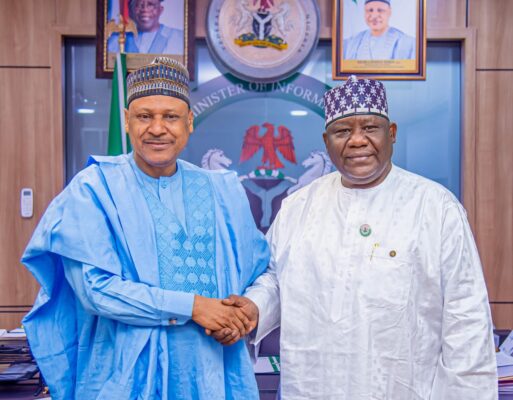
The Minister of Information and National Orientation, Mohammed Idris, has reaffirmed the Federal Government’s commitment to ensuring that public service reforms are not only implemented but clearly communicated to Nigerians to strengthen transparency, accountability and digital governance.
The Minister stated this during a courtesy visit by the Director-General, Dasuki Ibrahim Arabi and the management team of the Bureau of Public Service Reforms (BPSR) to his office in Abuja on Wednesday.
He stressed that communication is central to the success of any reform programme.
“Reforms must not only be implemented; they must also be effectively communicated. Where reforms are not properly understood, there is always resistance. Our duty is to ensure Nigerians understand that these reforms are designed for their greater good,” he said.
ADVERTISEMENT
He commended BPSR for sustaining institutional reforms across the public service and described reform as essential to national development.
The Minister pointed to the digitisation of Nigeria’s public financial management system as one of the most impactful changes in recent years.
According to him, the end of paper-based financial processes has improved transparency, blocked leakages and strengthened accountability across Ministries, Departments and Agencies (MDAs).
“Gone are the days when contractors rushed ministries at year-end to collect cheques. Today, the system is digitised. If the banking sector can operate seamlessly across Nigeria using technology managed by Nigerians, then our public service can work efficiently too,” he said.
The Minister added that structural reforms must be supported by attitudinal change.
ADVERTISEMENT
He explained that the inclusion of National Orientation in the Ministry’s mandate reflects the Federal Government’s resolve to promote patriotism, civic responsibility and shared ownership of public institutions.
He also disclosed ongoing efforts to modernise and digitise Nigeria’s archival system to preserve institutional memory and prevent policy gaps.
He stressed the importance of media and information literacy in tackling misinformation, deepfakes and artificial intelligence-driven manipulation.
He assured the delegation that agencies under the Ministry, including the Nigerian Television Authority (NTA), Federal Radio Corporation of Nigeria (FRCN), Voice of Nigeria (VON), and the News Agency of Nigeria (NAN), will continue to amplify reform milestones and ensure that Nigerians are properly informed.
Earlier, the Director-General of BPSR said the visit was to strengthen collaboration with the Ministry to accelerate reforms, improve communication, and enhance transparency across MDAs.
ADVERTISEMENT
Earlier, the Director-General of the Bureau of Public Service Reforms stated that the visit was aimed at strengthening collaboration with the Ministry to accelerate reform communication and enhance transparency across MDAs.
He outlined the key pillars of the National Strategy on Public Service Reforms, which focus on improving governance standards, strengthening national development planning, digitising public financial management, and promoting citizen engagement.
“Public service reform is not a one-off intervention; it is a continuous process of strengthening institutions, improving accountability, and leveraging technology to deliver better outcomes for citizens. Our partnership with the Ministry of Information and National Orientation is critical to ensuring that these reforms are clearly communicated, properly understood, and sustainably implemented across all MDAs,” the Director-General stated.
The DG noted that digitisation reforms have significantly reduced irregularities such as ghost workers and improved payroll integrity across federal, state, and local governments.
He further emphasised the need for improved compliance with the Freedom of Information (FOI) Act and encouraged MDAs to proactively disclose budgetary and operational information on their official platforms.
ADVERTISEMENT
He also highlighted ongoing efforts to enhance digital literacy among public servants, including training on the responsible use of emerging technologies such as artificial intelligence to safeguard government communication systems.
ADVERTISEMENT
ADVERTISEMENT