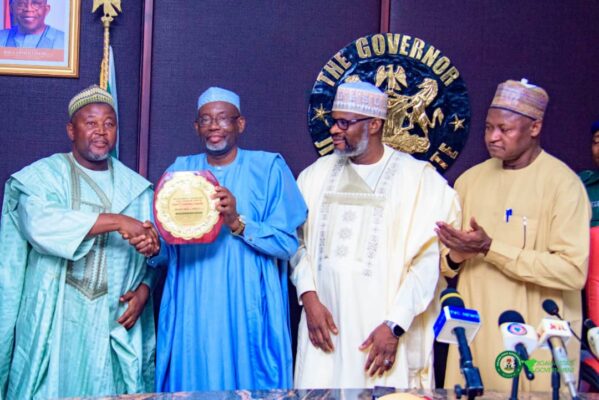
The Nigerian Union of Teachers (NUT) has honoured the Jigawa State Governor, Malam Umar Namadi, with the award of “Best Performing Governor in Northern Nigeria” in the Education Sector, describing him as a visionary, exemplary, and teacher-friendly leader whose reforms have significantly elevated the state’s education sector.
This was disclosed in a statement made available to TVC on Friday, signed by Hamisu Mohammed Gumel, the Chief Press Secretary to the Governor.
According to the statement, the award presentation took place at the Government House, Dutse, when the NUT delegation, led by the Deputy National President of the Union, Comrade Muhammad Hambali, and the Jigawa State Chairman, Comrade Abdulkadir Yunusa, and comprising NUT chairmen of all the 19 northern states, paid a courtesy visit to the governor.
While making his remarks, Comrade Hambali said the decision to honour Governor Namadi was driven by his outstanding performance and firm commitment to raising the standard of education in Jigawa State, noting that while several states struggled with salary arrears, layoffs, and refusal to implement the national minimum wage, Jigawa under Governor Namadi charted a different course.
“You are a visionary leader, an exemplary leader. And as the popular saying goes, “What is good for the goose is good for the gander.” It is on this basis that the Nigerian Union of Teachers has deemed it necessary to honour you for your outstanding performance and your commitment to raising the standard of education in Jigawa State,” he said.
According to him, the governor not only implemented an enhanced salary structure for teachers but also continued to hire more educators to strengthen the system at a time when other states were downsizing their education systems.
“When other governors refused to implement the national minimum wage, Governor Namadi implemented a jumbo-sized salary for teachers in Jigawa State. When other governors were sacking or retrenching teachers and workers, our Governor Namadi was busy laughing, smiling, and recruiting more teachers—and not unnecessarily, but because the system needed them. While other states delay salaries, salaries are paid on or before the 20th of every month in Jigawa. For this, Your Excellency, we say thank you.”
Comrade Hambali urged other governors across the country to visit Jigawa and study Governor Namadi’s model of educational development, describing him as “a teacher-governor for all governors in Nigeria.”
“It is on this note that I call on all governors in Nigeria to come to Jigawa and learn from Your Excellency—to study and emulate the good work you are doing in education. You are a “teacher-governor” for all governors in Nigeria.”
Read Also
He added that the NUT president had similarly encouraged the union to appreciate and celebrate Governor Namadi for his patriotism, fear of God, and people-centred governance, especially as the administration progresses toward 2027.
“That is why Mr President said that when we come here, we must appreciate you, celebrate you, and pray for you—especially as we approach 2027. Insha Allah, this administration will continue to rise higher and higher.”
Responding, Governor Namadi expressed his appreciation for the visit and the honour bestowed on him by the NUT leadership, saying that the honour belongs to the teachers as well.
“On behalf of the government and people of Jigawa State, I want to thank you for this initiative. You are seeing our modest contribution to the education sector and feel that we deserve to be honoured,” he said.
He added, “Our teachers fall in line with our agenda, and they feel we are partners in progress, and they agree that we should work together to improve the learning outcomes in our state. So I want to dedicate this award to our teachers for their commitment, for their hard work, and for their resilience.”
The governor used the occasion to highlight key reforms undertaken by his administration and reaffirmed the administration’s commitment to continued investment in the education sector.
“The first thing we did when we came here was to separate the education ministry into two—now the principle of basic education and the principle of wider education—just to introduce bureaucracy to policy implementation. And I want to confirm to the national president that the decision has paid off.
“We have invested a lot in education, and we will continue to invest,” the Governor reaffirmed