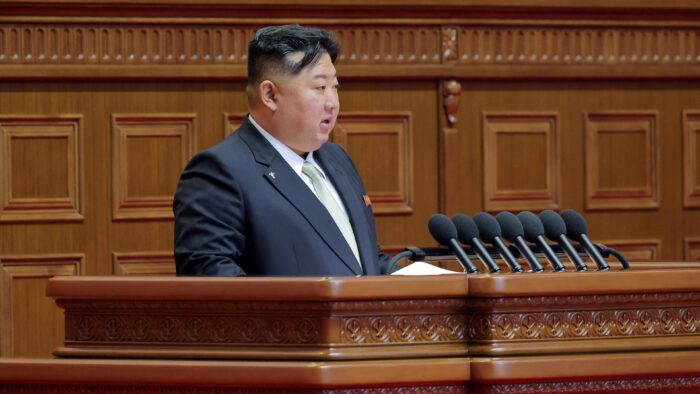
Kim Jong Un has again been chosen as General Secretary of the ruling Workers’ Party of Korea, according to state media.
The announcement was made at the party’s Ninth Congress in Pyongyang on Sunday, a move widely seen as a formality given that the Kim family has ruled the country since the late 1940s.
State-run Korean Central News Agency (KCNA) said that under Kim’s leadership, North Korea had “radically improved” its war deterrence capability, “with the nuclear forces as its pivot”.
Despite long-standing international sanctions, the country has continued to expand its nuclear weapons programme, regularly testing intercontinental ballistic missiles in defiance of United Nations restrictions. However, the secrecy of the regime makes it difficult to independently assess the full extent of its military progress.
Kim assumed power in 2011 following the death of his father, Kim Jong Il, and has since invested heavily in nuclear and missile development, significantly heightening tensions with the West, particularly the United States.
He is expected to outline the next phase of the country’s weapons programme during the ongoing congress, which began on 19 February. Ahead of the meeting, North Korea unveiled what it described as a new range of nuclear-capable rocket launchers.
Held roughly every five years over the past decade, the party congress is regarded as the country’s most important political gathering. With about 5,000 party members reportedly in attendance, it offers a rare insight into the inner workings of North Korea’s opaque political system and its policy priorities, including foreign affairs and nuclear ambitions.
While Kim remains firmly at the helm, the party’s presidium — its executive committee — has undergone significant changes since the previous congress in 2021. State media reported that more than half of its 39 members have been replaced.
In his opening address, Kim pledged to strengthen the economy and improve living standards, describing them as “heavy and urgent historic tasks”.
Attention has also focused on Kim’s daughter, Ju Ae, amid speculation about succession.
Earlier this month, South Korea’s intelligence agency suggested that she had been identified as a potential heir.
Believed to be about 13 years old, she has increasingly appeared alongside her father at official events, including missile inspections and a recent military parade in Beijing.
That parade marked a rare occasion where the leaders of North Korea, China and Russia appeared together, signalling solidarity amid heightened geopolitical tensions.
Chinese President Xi Jinping reportedly called Kim on Monday to congratulate him on his re-appointment, expressing a desire to “write a new chapter” in bilateral relations.
China remains North Korea’s largest trading partner and primary source of economic assistance.
However, Beijing has also expressed concern over Pyongyang’s expanding nuclear ambitions and its growing ties with Russia, developments that could further destabilise the region.