
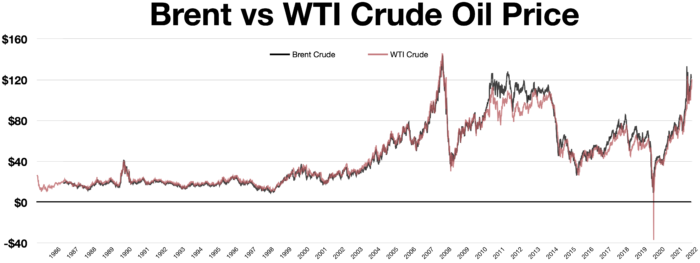
Global oil prices spiked sharply on renewed tensions around the Strait of Hormuz, with Brent crude rising to $118.2 per barrel and West Texas Intermediate (WTI) climbing to $102.5.
The surge has created an unusually wide gap between the two key benchmarks, reflecting heightened risks to global seaborne oil supply.
The rally was triggered in part by remarks from Donald Trump, who, in a social media post, urged countries struggling to secure jet fuel due to disruption in the Gulf to either purchase supplies from the United States or secure oil independently.
Market analysts say the divergence between Brent and WTI highlights how geopolitical shocks are disproportionately affecting internationally traded crude.
Brent, which prices waterborne oil cargoes, is more sensitive to disruptions in shipping routes such as Hormuz—a critical chokepoint that handles roughly 20 per cent of global oil and liquefied natural gas trade.
In contrast, WTI is largely landlocked within the United States and less immediately exposed to maritime disruptions, even as it continues to post gains.
According to a Reuters survey, the ongoing conflict involving Iran and the disruption of flows through Hormuz have triggered one of the sharpest upward revisions in annual oil price forecasts on record.
European authorities have also raised concerns, with the European Commission warning of prolonged supply disruptions, particularly for refined products such as jet fuel and diesel.
Analysts note that the current market dynamic is sending a strong bullish signal for Brent-linked crude and refined products tied to international cargo markets, especially across the Atlantic Basin.
Meanwhile, the United States is increasingly being viewed as a relatively stable source of supply, helping to cushion domestic markets and limit the upside for WTI compared to Brent.
Despite the widening spread, U.S. crude prices remain elevated overall, though they continue to lag behind the sharper gains seen in global benchmarks as geopolitical risks reshape energy markets.