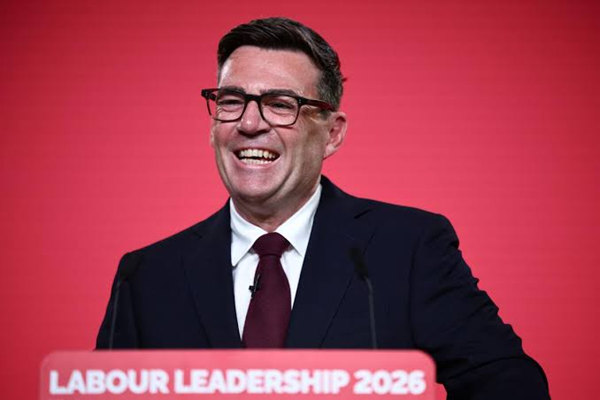
Andy Burnham has officially become the Prime Minister of the United Kingdom after accepting King Charles III’s invitation to form a new government at Buckingham Palace, promising a fundamental reset of British politics and the economy while pledging immediate action to ease the cost-of-living crisis.
In his first address to the nation outside 10 Downing Street on Monday, Burnham acknowledged the political instability that has gripped the UK in recent years and vowed to restore confidence in government through sweeping reforms.
Speaking shortly after his audience with the King, the new prime minister said the country had experienced frequent changes in leadership, describing the moment as an opportunity for reflection and renewal.
“I have just come from Buckingham Palace, where I have accepted His Majesty the King’s invitation to form a government,” Burnham said.
READ ALSO: JUST IN: Andy Burnham Becomes UK Labour Leader
Reflecting on Britain’s recent political turbulence, he added: “I am acutely conscious that I am the sixth person in the last ten years to walk up this street, the seventh Prime Minister since 2016. Making this a moment for reflection and new resolution.”
ADVERTISEMENT
Burnham said his administration would seek to restore political stability and rebuild public trust, acknowledging growing frustration among citizens.
“Britain needs to show the world that we can regain our stability once again, and that is our challenge, to make politics work, to make it work better,” he said.
Addressing widespread public dissatisfaction with politics, the prime minister admitted that successive governments had fallen short.
“I know people at home are fed up with politics. I hear you. And I want to be honest with you. We have not been good enough, and we need to be better. We will be.”
Burnham pledged to introduce what he described as the biggest political and economic transformation Britain has seen in four decades.
ADVERTISEMENT
According to him, the government will pursue “the biggest changes in the last forty years” through “a new political model and a new economic model.”
He argued that decisions made in the 1980s left many communities behind, saying excessive centralisation of political power, widespread privatisation and de-industrialisation had contributed to long-term regional decline.
To reverse that trend, Burnham said his administration would devolve more powers to local communities, strengthen public control over essential services and use public procurement to support British industries.
“We will take power out of here and carry it into every postcode in the land so that they can do more,” he said, adding that the government would work towards “re-industrialising Britain, using public procurement to back British industry.”
The prime minister also announced plans to publish a 10-year national development strategy later this year.
ADVERTISEMENT
“Later this year, I will bring forward a new plan for Britain, a 10-year plan, laying out a path from where we are now to where I believe we all want Britain to be,” he said.
While the long-term strategy is being developed, Burnham promised immediate interventions to cushion the impact of rising living costs.
“I will set out some of those measures starting tomorrow, including how we pay for them,” he said.
The new administration also plans to create more employment opportunities for young people by reforming the education system, expanding mental health support and increasing the construction of council homes.
Burnham said those measures would help reduce welfare spending while ensuring the government remains committed to its fiscal rules and defence obligations.
ADVERTISEMENT
He further pledged to build what he described as a more preventative state by investing in people’s wellbeing rather than responding to crises after they occur.
As his first official directive, Burnham announced that his government would begin efforts to eradicate homelessness.
“I will soon go through that door behind me and issue my first instruction: to end rough sleeping in our country,” he declared.
The prime minister concluded by calling on Britons to unite behind a shared national purpose, promising to place people’s welfare at the centre of his administration.
“I will put the care of people at the heart of everything I do. I will give this my all, and I ask you all to pull with me. Let’s build a new national sense of unity, of common purpose and positivity. Let us make this the moment when Britain starts to believe again. The moment we bring back hope.”
ADVERTISEMENT