
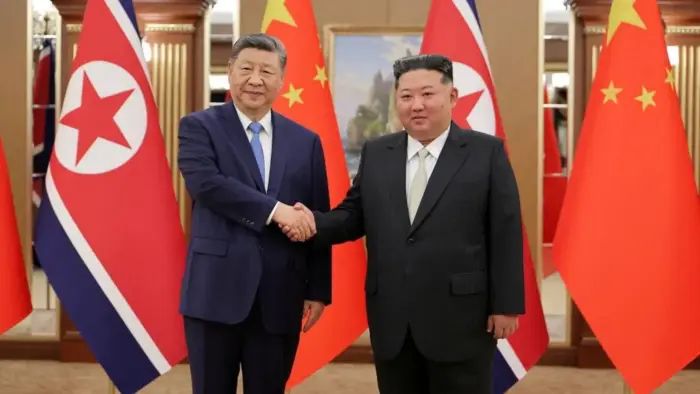
Chinese President Xi Jinping has concluded a two-day state visit to North Korea, marking his first trip to the country since 2019 and underscoring efforts by Beijing to reinforce its influence over Pyongyang.
During the visit in Pyongyang, Xi was received by North Korean leader Kim Jong Un with elaborate ceremonies, including a red-carpet welcome and military-style displays, reflecting the symbolic importance of the relationship between both countries.
According to state media reports, Kim described Xi’s visit as evidence of the “utmost importance” Beijing places on bilateral ties, while both leaders reaffirmed their long-standing friendship and strategic cooperation.
At a banquet, Xi said China and North Korea are “linked by mountains and rivers and share a common destiny,” emphasising the need to deepen high-level exchanges and people-to-people relations, according to Chinese state outlet Xinhua.
Kim, in response, reiterated Pyongyang’s commitment to maintaining close ties with Beijing and expressed support for China’s “One China” policy, while highlighting solidarity amid what he described as global “upheaval.”
ADVERTISEMENT
The visit comes at a time when China is seeking to reassert influence over North Korea, which has drawn closer to Russia in recent years amid ongoing international sanctions over its nuclear programme.
Notably, state media readouts did not include discussions on denuclearisation, reflecting Beijing’s increasingly cautious public stance on the issue.
Xi was accompanied by senior Chinese officials, including foreign minister Wang Yi and defence minister Dong Jun, signalling the diplomatic weight attached to the visit.
Both leaders also visited the Friendship Tower in Pyongyang, which commemorates Chinese soldiers who fought in the Korean War, and planted a fir tree symbolising what officials described as “evergreen friendship.”
While the visit featured strong displays of unity, analysts note that underlying differences remain, particularly regarding North Korea’s economic model and its reluctance to adopt China-style reforms.
ADVERTISEMENT
Despite this, the trip reinforced the enduring strategic partnership between Beijing and Pyongyang at a time of shifting global alliances and rising geopolitical tensions.