
The Independent National Electoral Commission (INEC) has explained its decision to appeal two recent Federal High Court judgments concerning aspects of its timetable and schedule of activities for the 2027 general elections, warning that inconsistent rulings could create uncertainty and undermine the integrity of the electoral process.
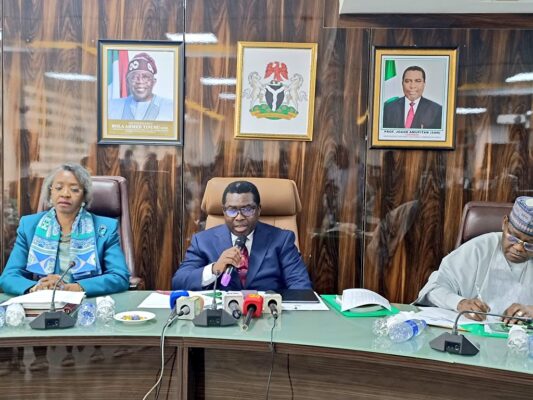
The Chairman of the Commission, Joash Amupitan, gave the explanation on Tuesday in Abuja during his opening remarks at the Second Quarterly Consultative Meeting with leaders of political parties, as seen on the Commission’s official X handle.
Amupitan said the Commission was already challenging the rulings in court to obtain authoritative pronouncements from the appellate courts, stressing that electoral timelines were interconnected operational processes critical to credible elections.
He referenced Suit No. FHC/ABJ/CS/517/2026, Youth Party v. INEC, delivered on May 20, 2026, in which the court questioned certain timelines in INEC’s election timetable.
ADVERTISEMENT
He also cited a second judgment in Suit No. FHC/ABJ/CS/720/2026, Social Democratic Party (SDP) v. INEC, delivered on May 26, 2026, which upheld the Commission’s authority to issue an electoral timetable but nullified specific timelines on nomination and substitution of candidates.
READ ALSO: INEC Appeals Court Ruling Voiding Part of 2027 Election Guidelines
“These judgments raise important legal questions concerning the extent of the Commission’s constitutional and statutory powers in coordinating and regulating electoral activities,” he said.
The INEC Chairman said the Commission’s timetable was designed as a unified framework rather than isolated activities, noting that several critical electoral processes are not expressly covered by statutory timelines but remain essential to election administration.
He listed such processes to include submission and verification of party membership registers, monitoring of party primaries, pre-upload of primary results, printing of ballot papers and result sheets, configuration of BVAS machines, and other logistical and statutory obligations under the Electoral Act 2026.
“The Commission therefore considers it imperative that all electoral activities be harmonised within a coherent and workable framework that promotes certainty, transparency, administrative efficiency and equal treatment of all political parties,” he said.
ADVERTISEMENT
Amupitan assured stakeholders that the Commission remained committed to conducting the 2027 general elections in line with constitutional provisions and the Electoral Act, despite the ongoing legal process.
Turning to election preparations, he disclosed that the register of voters for the Ekiti State governorship election scheduled for June 20, 2026, now stands at 1,059,360 voters, following the addition of 66,664 new registrants from the Continuous Voter Registration exercise.
Read Also
He added that 2,103 double registrations were removed to safeguard the integrity of the register, while logistics, technology deployment and personnel training were on course for the poll.
He said all 2,445 polling units across Ekiti State’s 16 local government areas would open simultaneously at 8:30 a.m. on election day.
The INEC Chairman also confirmed that bye-elections would hold the same day in six constituencies, including Enugu North, Nasarawa North, Rivers South-East, Ondo South Senatorial District, Dawakin Kudu/Warawa Federal Constituency in Kano State, and Zuru State Constituency in Kebbi State.
ADVERTISEMENT
Amupitan further disclosed that preparations were ongoing for the Osun State governorship election scheduled for August 15, 2026, urging political parties to comply strictly with electoral timelines and guidelines.
On the 2027 general elections, he announced that the Commission would issue access codes to political parties on June 26, 2026, for use of its Candidate Nomination Portal, warning that the system would close automatically without extension after the deadline.
He also urged political parties to intensify voter mobilisation and education efforts, particularly in support of the ongoing Continuous Voter Registration exercise.
Amupitan expressed concern over ongoing court cases involving internal party leadership disputes, describing them as distractions that could affect electoral preparations, and urged parties to resolve such issues internally.
Responding on behalf of political parties, the National Chairman of the Inter-Party Advisory Council (IPAC), Yusuf Mamman Dantalle, supported INEC’s decision to appeal the judgments, saying conflicting court decisions had created confusion for stakeholders.
ADVERTISEMENT
Dantalle, however, called for urgent reform of the Electoral Act 2026, arguing that some provisions were creating operational challenges during party primaries.
He specifically faulted restrictions limiting parties to consensus and direct primaries, noting that the absence of indirect primaries had placed undue strain on candidate selection processes.
He also condemned recent incidents of political violence in Osun State, urging political actors to adopt issue-based campaigns and avoid actions capable of destabilising the democratic process.
“No political ambition is worth the loss of human life, the destruction of property, or the destabilisation of communities,” he said.