The Lagos State government has committed more than N140 billion to social protection initiatives aimed at improving residents’ lives and ensuring that “no Lagosian is left behind” in the state’s development agenda.
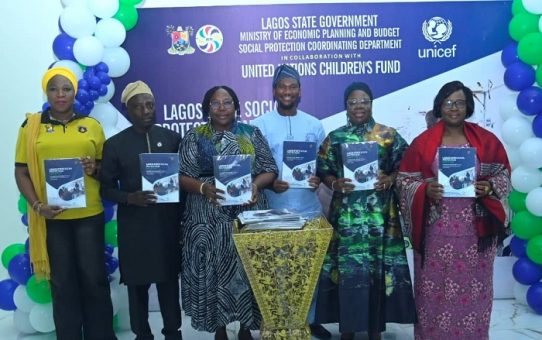
The disclosure was made by Mrs. Olayinka Ojo, Permanent Secretary of the Ministry of Economic Planning and Budget, during the Lagos State Social Protection Partners Forum. She described the budgetary allocation as “a clear demonstration of the government’s commitment to shared prosperity and inclusive growth.”
“Mr. Governor, Mr. Babajide Sanwo-Olu, has emphasised his commitment to positively impacting the lives of Lagosians, with over 20 social-focused MDAs, more than 90 social interventions, and over N140 billion in budgetary allocation,” Mrs. Ojo said.
She explained that the funding reflects the administration’s determination to build a coordinated social protection system that reaches vulnerable residents across all local governments and local council development areas.
“Today marks a significant milestone in our state’s commitment to the principle of shared prosperity,” she added, noting that the government is establishing standards and systems for social investment designed to eradicate poverty.
READ ALSO: Sanwo-Olu Launches Lagos Financial Hub Blueprint
The Permanent Secretary highlighted that the Lagos State Social Protection Policy, approved in 2020, targets key areas such as livelihoods, health, education, gender equality, youth empowerment, support for persons living with disabilities, and human capital development.
The policy is implemented through the Social Protection Coordinating Department, which serves as the secretariat for 22 identified MDAs working via a technical working group.
She noted Lagos stands out as the only state in Nigeria with a dedicated Social Protection Coordinating Department.
“While other states have remained at the residual creation of the Federal Government of Nigeria, the Lagos State government has taken it further, investing your taxes and revenue into ensuring that your lives are catered for,” she said.
Mrs. Ojo also revealed plans to implement an advanced data management system to map vulnerable populations using geospatial technology combined with community-level engagement.
“We intend to create a system that does not just share out the so-called shared prosperity, but identifies where the vulnerable are and ensures inclusion and empowerment, especially for our youth,” she said.
She added that in 2025, the state will strengthen downstream integration of its social register through engagements with Community Development Association chairmen, Community Development Committee coordinators, and market leaders.
Read Also
“Who will first recognise and identify those who are vulnerable in their community? It takes the community leaders, those who dwell in the same community with the vulnerable people,” she explained.
Speaking at the forum, UN Women Country Representative Beatrice Eyong underscored the need for gender-responsive social protection systems, noting that fewer than one in ten people are covered by any form of social protection.
“At the heart of effective social protection is the need for a fairer, more responsive approach that recognises the different realities, beliefs and experiences of women, girls, men and boys,” she said, praising Lagos State Government’s leadership in placing inclusion and dignity at the centre of governance.
Eyong further highlighted Nigeria’s poverty challenges: “Women are more likely than men to live in poverty, especially in illiterate households, due to limited access to civil, legal, land, trade and social insurance rights. According to the National Bureau of Statistics, over 70 per cent of working women in Nigeria live in poverty-impacted states, while immigrated households account for 32 per cent. If you calculate that, it means Nigeria has at least 40 million persons—boys and girls, men and women—living in those households.”
She warned that without deliberate intervention, poverty would continue to deepen.
UNICEF Social Policy Manager Muhammad Okorie commended Lagos for its forward-looking social protection programmes. “When you think long-term, you are already thinking about human capital development.
You are thinking about how to build the next generation that will drive the economy,” he said, highlighting the link between social protection and economic competitiveness.
Okorie also noted Lagos’ multi-sectoral approach: “They are already thinking beyond 2026, projecting into 2027,” he said, praising the state for prioritising grassroots engagement and long-term development.
Executive Secretary of the Lagos State Scholarship Board, Mrs. Daranijo, highlighted the importance of collaboration in ensuring that financial constraints do not deny children access to education.
“Partnering for the good of the community can never go wrong. The government continues to support students and the institutions that serve their communities,” she said.
She added that the scholarship programme works closely with communities to verify family circumstances so that children can continue schooling despite financial challenges.
The forum also featured the formal presentation of the Lagos State Social Protection Report 2025, titled “Leaving No One Behind: Tracking Social Protection Coverage and Vulnerability.”