
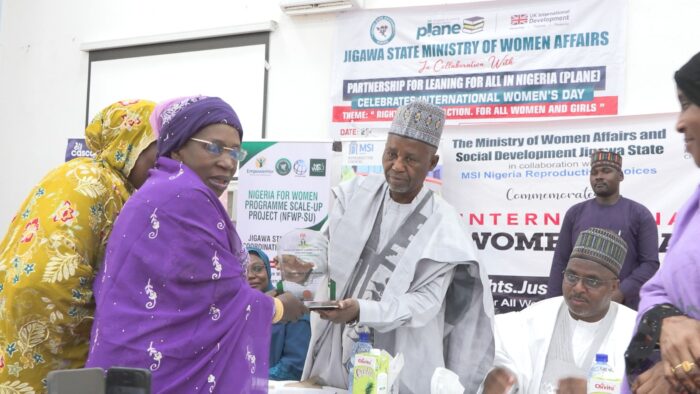
The Jigawa State Government has emphasised that women’s empowerment is key to driving real change.
Speaking at the graduation of 500 women who completed a comprehensive livelihood training programme to mark the 2026 International Women’s Day, Head of Service Muhammad Dagaceri said the government is intentional about women’s inclusion in all aspects of state development.
“The state remains committed to advancing women’s development because investing in women is central to economic growth and social stability,” Dagaceri said.
He added that women are increasingly being integrated into appointments and political processes across Jigawa, reflecting the government’s commitment to inclusive governance.
The graduation ceremony showcased the participants’ newly acquired skills, which the government hopes will empower them to contribute meaningfully to household incomes and community development.
The beneficiaries were trained in practical and marketable skills such as soap making, disinfectant production, fashion design, and makeup artistry—skills considered vital for self-reliance in today’s economy.
Dagaceri stressed that empowering women with such skills will not only create sustainable income opportunities but also improve family welfare and contribute meaningfully to the state’s economy.
Read Also
The training was organised by the Ministry of Women Affairs in partnership with Keystone Bank, which also provided financial support to the beneficiaries.
In total, about 12 million naira was disbursed, with each of the 500 women receiving 25,000 naira as start-up capital to kick-start their businesses addressing one of the major barriers to entrepreneurship access to funding.
Speaking at the event, the Commissioner for Women Affairs and Social Development, Hadiza Abdulwahab, said women in Jigawa are actively involved in governance and development initiatives.
She emphasized that women are not seeking competition with men, but inclusion and recognition.
She also urged the beneficiaries to remain focused, make productive use of the opportunity, and contribute positively to society, especially as the country prepares for future elections.
Beyond economic empowerment, the women were also trained on making informed health decisions, further strengthening their capacity to lead healthier and more productive lives.
With skills, financial support, and increased inclusion, Jigawa State is positioning its women as active contributors to development.